Showing posts with label facebook. Show all posts

Tuesday, August 27, 2013

How A New Button Will Revolutionize Facebook Forever

Facebook doesn't know you. No matter what Mark Zuckerberg says. Sure, the Feds might have made 25,000 requests for user data, but it's unlikely they learned anything other than Facebook users' affinity for cuddly cat photos and re-posted Pinterest quotations.

For a clear example of Facebook's failure to know who you are, look no further than the quiet end to Facebook Gifts, the social network's attempt to get you to buy real-life items for your friends' birthdays, engagements, and anniversaries.

As Forbes' contributor Mark Rogowsky points out, Facebook Gifts was a laughable failure:
"I looked at it four times in the past few days just to get a sense of what Facebook thought my friends might like. Three female friends had birthdays. Only of them has a young child, but somehow, all of them are good candidates for an $11 “mustache pacifier,” because, as Facebook puts in, “even babies need disguises.” There is so much wrong with this gift, it’s hard to know where to begin."
The issue is that, for all its claims about tracking users' behavior online, Facebook is unable to parse what "Likes" mean. Did you "Like" your friend's post about hamster balls because you want a hamster ball yourself, or did you merely think it was cute? Do you "Like" Pizza Hut because you find their pizza to be superior, or were they offering a 25% coupon if you clicked "Like" on their Facebook page? "Like" is such a general term, it can be maddeningly obscure: you may "Like" mustache pacifiers because you think they're a hilarious thing, but you'd never actually spend the money to buy one.

It's a well-known story that before Facebook decided on the "Like" button, they considered creating an "Awesome" button. Zuckerberg and Co. made the wise choice to go with "Like," which was more universal across cultures and age groups, applicable as a noun and a verb, and had a wide enough breadth to be used in many different contexts. The "Like" button helped spread Facebook far and wide because it didn't require much thought or discernment from the user-- one could "Like" something as a gesture of support for a friend, they could "Like" it because it made them smile, they could "Like" an opinion they agreed with or an article they thought was worth sharing. "Like" and "Share," the two methods of acknowledging and spreading content through Facebook's news feed, are pretty much the same. I'd argue there's no distinction between the two, other than "Share" allowing someone to pass along objectionable or shocking content without having to awkwardly "Like" it.

But while the vagueness and multiple applications of "Like" and "Share" helped grow Facebook, they're terrible descriptors. They lack the ability to communicate desire. And if you're a company that ultimately needs to make money by selling things (or advertising them), that's a problem.

However, a recent decision by a federal judge in Michigan could pave the way for a new button that will revolutionize Facebook forever.

What is this magical button? A "Want" button.

Back in 2010, Facebook was working on the idea. They even tested it out among a few retailers in 2012. However, another company, based in Detroit, had previously created an app called "Want Button" that allowed users to create wishlists of products on Facebook.The two parties were locked in a legal struggle until earlier this month, when a judge tossed the case and both companies agreed the court battle was over.

The decision paves the way for something that has been in the works for a while. TechCrunch thought it would happen two years ago. The legal hurdle cleared, its likely we'll see a "Want" button instead of "Like" appear on e-commerce sites and beneath product posts on your Facebook newsfeed sometime in the near future.

Anyone arguing that users won't "Like" the new button (and there have been many naysayers, mostly from the vocal "add a dislike button" crowd) haven't been paying much attention to sites like Pinterest, where users frequently create whole boards of aspirational items they desire. By getting users to voluntarily reveal the products and services they want, rather than just "Like", Facebook can create a better profile of its users, enabling advertisers to better target their audience and allowing the site to recommend complimentary products as gifts. Facebook Gifts 2.0 would draw from a better database of its users' desires and be able to churn out more accurately curated suggestions. None of this is a bad thing.... wouldn't you rather Facebook recommended birthday gifts you'd actually want?

The "Want" button is coming, people. And I expect it to help Facebook greatly in its efforts to enter the e-commerce field-- where the company will finally justify its billion-dollar valuation.

Tuesday, October 18, 2011

What Happens When You Fall For The Free Starbucks/iPad/Anything Facebook Scam

Never a good sign when you log into Facebook and your newsfeed looks like this:

While it would be wonderful to believe that somehow, EVERY SINGLE PERSON YOU KNOW, is in on a GREAT, UNBELIEVABLE FREE DEAL, when you see this sort of thing happening, red flags should immediately go up.

First, you should be struck at how many of your friends, including people you barely know, are touting the deal. This may include people who normally don't post things at all. People who haven't posted a status update in years. Why now?

Second, look at that deal. $50! That's like 10 coffees! Unbelievable! Yes, unbelievable.

Third, look at the web address. Something odd. While they all sound, vaguely coffee-related... they're all different. And don't have that comforting ".com" address.

This is because it's a scam. Here's what happens when you click it.

First, it insists that you share the deal with all of your friends in order to "activate" the freebee. This is why you see so many people sharing the link. This step comes before people may realize things are amiss. Sheeple! Bah bah!

Then, it leads to a site that asks you to take a survey. This site surreptitiously loads tracking software onto your computer (most browsers will not warn you about this). It does this EVEN IF YOU DON'T FILL OUT THE SURVEY. From this moment on, any move you make online will be tracked by whomever created the survey page. And guess what, it wasn't Starbucks.

The survey will ask for personal information. This information is used to figure out how old you are, where you live, what your email address is, what your passwords are, what credit cards and banks you use... etc. With this full portrait, some guy in Nigeria, or elsewhere, can easily impersonate you online. They may use your information to hack into your email and accounts, steal money from you and the people you know.

If you clicked on the link:
 
1. Immediately clear your cookies and internet cache.

2. Run a (reliable) anti virus program to make sure your computer hasn't been infected with malware (bad software).

3. Then change your Facebook password, email password, and any other passwords you believe may have been compromised (any site you visited after clicking the link).

4. Finally, warn others that the link is indeed a scam. Report it to Facebook.

In the end, a scam is very easy to spot. If Starbucks, or any other business, was to offer a deal, they'd offer it on their official Facebook page or website. If the deal is coming from somewhere else, it's not legit.

Second, look at what they're giving away: $50 Fifty Dollars!?!?! A free iPad???! These are incredibly generous giveaways, far beyond what one would expect from an American business (have you even been following Occupy Wall Street?) Even Groupon only takes off 50%, and that's often fraudulent.

Starbucks, Apple, and other companies would never give away so much of their product for free. Scammers rely on American greed to spread their scams far and wide. If they simply offered a 10% off coupon, their scam would seem more realistic, but it wouldn't be enough to motivate a lot of people to fill out the whole survey and go through the entire process.

If you see a deal that's too good to be true, it is. That's a rule of thumb you should always follow.

If you really want to be a wishful thinker, at least do yourself the favor of Googling the deal, and visiting the corporate website first. You can check out mainstream media too-- if a deal this big really was being offered, it would certainly be covered.

Think before you link. You'll be thankful you did.

Wednesday, October 12, 2011

Who's Searching For You On Facebook?


Ever want to know who's looking you up on Facebook but not requesting you as a friend? Just click on "People You May Know" on your Facebook's homepage.

Facebook draws these "People You May Know" from several different sources, not just your email contacts or address book.

"People You May Know helps you find people you are likely to know. We show you people based on mutual friends, work and education information, networks you’re part of, contacts you’ve imported using friend finder and many other factors."

The most obvious of these other sources, and least controversial, is people with whom you have mutual friends. Some kid who has 45 friends in common with you is most likely someone you know.

Then of course, Facebook knows who works at the same company, or goes to the same school as you, from the info that appears in your profile.

Perhaps less obvious, they also know your IP address, so people using the same internet connection as you may pop up (now you know who's stealing your WiFi.)

However, you may notice suggested people with whom you have no mutual friends. People who aren't in your address book. People who share no school or affiliation that you've listed on your profile. People who have never used your internet connection. You may notice, though, that some of these people do, in fact, look familiar. They may be an acquaintance, a waiter at a restaurant you like, your landlord. You don't even know their last name! How the heck did Facebook know they might know you?

Does Zuckerberg have a zeppelin in the sky from which he watches and records our every human interaction?


Possibly. But that's not how they come to suggest these people. They suggest them because that person has searched for your name on Facebook. According to the internet message board chatter.

Take a moment for that to sink in. Now recall all the people you may have looked up on Facebook, including ex-girlfriends, the hot barista down at the Starbucks, that guy who lives in apartment 12 B. If you typed their name into Facebook's search box, you will pop up on their "People You May Know" list.

Just remember, when you search on Facebook, you're not searching anonymously. You're tipping off whoever you're searching for. You're letting them know you've been looking for their profile.

Rumors are circulating that Facebook is even sending emails to these people, saying that you'd like them to join Facebook. While not confirmed, this is pretty alarming.

Up until now, most of the warnings surrounding Facebook have centered around the information you choose to reveal. This however, goes much deeper-- Facebook using information you had no idea was being revealed at all... and giving you no choice to protect your privacy.

Tuesday, February 15, 2011

The Facebook Effect: Tunisia, Egypt and The Oscars


In 2003, President George Bush had a theory he thought would change the world. How much of the theory was actually his and not Dick Cheney's and his neocon buddies' is up for debate, but the gist of the idea was this: Get rid of Saddam Hussein, establish democracy in Iraq, and the rest of the Middle East would fall into freedom like a cascade of dominoes.

In 2011, we're seeing the Middle East falling into freedom like a cascade of dominoes. Huzzah! Were Bush and Cheney, gasp, actually right??

Well, yes and no. They were right about one thing: freedom is contagious. It's common sense, really. If your hard-earned money is being taxed, then you're funding your government. And if your government treats you like a slave, that breeds resentment. Freedom is the logical desire: the hope that your efforts will provide you, and not the members of your government, with a better life. The hope that one day, nothing will stand in the way of your happiness.

It makes sense that if the yoke of autocratic rule is thrown off in a country where that hope once seemed impossible--those elsewhere who similarly seek freedom will be encouraged to take action.

Autocrats rule by making their people believe that freedom isn't for them. They stay in power by making their people fear that without an iron fist, anarchy will take over. Once that illusion is dispelled, there's nothing left to hold back the floodgates of democracy.

But the Cheney-Bush Middle East domino theory was wrong, catastrophically wrong, about the agent of change. They believed military intervention would be the driver behind a people's revolution. According to them, the people would only rise up if they knew they had the backing of a superpower, the United States. Without military assistance from abroad, the people would be too scared to turn on their leaders.

We've recently seen otherwise. The revolutions in Tunisia and Egypt (and possibly elsewhere... Iran and Saudi Arabia being next in line), were not precipitated by the U.S. military intervention in Iraq and Afghanistan. Instead, they were sparked by another idea that developed in 2003.

Facebook.

From The New York Times:

After a strike that March in the city of Mahalla, Egypt, Mr. Maher and his friends called for a nationwide general strike for April 6. To promote it, they set up a Facebook group that became the nexus of their movement, which they were determined to keep independent from any of the established political groups. Bad weather turned the strike into a nonevent in most places, but in Mahalla a demonstration by the workers’ families led to a violent police crackdown — the first major labor confrontation in years.

Just a few months later, after a strike in Tunisia, a group of young online organizers followed the same model, setting up what became the Progressive Youth of Tunisia. The organizers in both countries began exchanging their experiences over Facebook. The Tunisians faced a more pervasive police state than the Egyptians, with less latitude for blogging or press freedom, but their trade unions were stronger and more independent. “We shared our experience with strikes and blogging,” Mr. Maher recalled...

After the Tunisian revolution on Jan. 14, the April 6 Youth Movement saw an opportunity to turn its little-noticed annual protest on Police Day — the Jan. 25 holiday that celebrates a police revolt that was suppressed by the British — into a much bigger event. Mr. Ghonim used the Facebook site to mobilize support. If at least 50,000 people committed to turn out that day, the site suggested, the protest could be held. More than 100,000 signed up.

“I have never seen a revolution that was preannounced before,” Mr. Ghonim said.

In Tunisia and Egypt, where the rights to public assembly were severely restricted, and free speech non-existent, Facebook became the logical place to organize and assemble a protest.

The youthful leaders of the respective opposition movements each took advantage of Facebook's age gap-- it's unlikely that Mubarak or Ben Ali were checking their Facebook newsfeeds or that their secret police even took note of the myriad Facebook groups dedicated to ousting their regimes. It's likely that Mubarak and Ben Ali, if they even thought about Facebook at all, thought about it like some harmless fad, a method that the youth of the nation used to share pictures and post baby bunny videos.

They soon discovered, however, that Facebook could be a powerful force. By bringing together people and their social networks, information could fly fast and unfiltered among dozens, hundreds, thousands of people at once. Dictators like Ben Ali and Mubarak relied on control of information to control their people. Facebook subverted that control, providing a conduit for mass communication that flowed free of government censors.

Freedom is contagious. But it didn't spread through military intervention. It's spreading through technological innovation.

In Apple's famous 1984 Macintosh TV spot, a hammer thrower shatters the Big Brother image lording over a population of slaves:


Twenty-seven years later, we're seeing the fulfillment of that promise: technology destroying totalitarian control. Apple is part of that-- leading the way with mobile devices that allow people access to information anywhere. Google is part of that too, bringing together facts and information from all perspectives and corners of the Earth-- it shouldn't surprise us that an Egyptian Google executive would be such an integral part of the Egyptian uprising.

Facebook completes the freedom-fighter's toolkit, providing a digital gathering place, a way to show people dreaming of a better tomorrow that they're not only not alone, but part of the majority.

Bush's military policy removed Hussein and the Taliban from power, but it didn't empower the people of Iraq and Afghanistan. Their revolution was stolen from them. Instead of rising up and grabbing control of their country, someone else grabbed it for them. And as a result, they got neither the leadership nor the constitution they wanted. They got... "America, F*ck Yeah!"

The wars in Iraq and Afghanistan left the people feeling powerless and helpless, dependent on a foreign nation for all their daily needs. All at the cost of billions of American dollars and thousands of American lives.

Of course, the inability to see the future is a condition shared by more people than just Bush and Cheney. In 2003, not even Mark Zuckerberg (and the Winklevoss twins) could have known that social networking would step into a pretty major global role as a real-world action driver. But what if? What if we had the patience not to go to war?

Would the regimes of Iraq and Afghanistan have fallen on their own, as their populations became more digitally connected? Or were their technological infrastructures so primitive that the world of Facebook would have been inaccessible to them, even eight years later?

These questions aren't addressed, or even hinted at in the blockbuster film, The Social Network, about the origins of Facebook. I liked the film, but the movie reduces Facebook to a hookup engine... one reason, I suspect, that Mark Zuckerberg wasn't its biggest fan. But one can't blame the writers and producers. The truth is, our awareness of the power of Facebook has only recently been heightened, by its use in Tunisia and Egypt, and its influence in the Tea Party movement of our own country. The true utilities of Facebook's social network have yet to be fully explored.

If Facebook can spark a democratic revolution in a place where such a thing seemed impossible... then are there any limits the the change it can ferment in the world?

Is Facebook the new military intervention?

Is Facebook... world peace???

If The Social Newtork wins an Oscar, it won't win it for what was depicted on screen: a vapid tale of success at all costs. It will win because the members of the Academy and all the rest of us know--even while we're posting stupid status updates and links to Justin Bieber videos--that Facebook isn't just a website, it's become something inextricable from our lives.

The future of the human race has always relied on the evolution of our communications. Our planet is a large one, and our experiences on it are diverse. The closer we can come together and the stronger the lines that connect us, the more difficult it will be for us to fall apart. Once upon a time, communiques sent by flaming beacons and carrier pigeons helped end wars. It's foolish to think of Facebook and WiFi as anything less than the latest in a series of innovations that will help transform the world into a better place.

Perhaps instead of sending armies to remove dictators, we should be sending routers and iPhones.

We're seeing the power of technology at work right now. In a cascade of dominoes set off not by a gun, but by the Like button.

Friday, January 14, 2011

New Facebook Profile Oddity

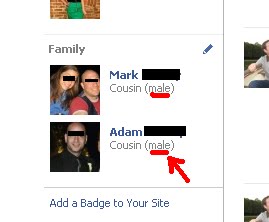
My Facebook profile was recently updated... and I find one thing a little bit odd:

Picture Censored To Protect Privacy, Potential Embarrassment

Why is it necessary to identify my family members as (male) or (female) in such a prominent way? Most everyone on Facebook lists their sex on their profile, but nowhere else on the site does someone's sex appear directly next to his or her name. I could understand it if this were Pat, or Alex, or Dee Snider, but Mark and Adam? I think it's pretty obvious they're not ladies.

Someone from Facebook care to explain this strange design choice?

Friday, October 01, 2010

The Social Network Opens Today

The Social Network opens today, and given how popular and essential Facebook has become, it's easy to forget that this movie could have featured a different social network entirely. Even as late as 2006, it wasn't clear who the social networking winner would be. I wrote the following article in 2006 for MSNBC. MSNBC never ran it, but I got some great quotes from Cameron Winklevoss, one of the villains (or victims, depending on how you look at it) in The Social Network movie. 

The MySpace That Wasn’t...
And The Ones Yet To Be
 
​Figure skater Sasha Cohen is doing it. So is Weezer frontman Rivers Cuomo. You can’t pick up a newspaper or magazine (even this month’s Playboy!) without hearing about MySpace. With more than 75 million members, the social networking site dominates the news. Why did it succeed while others failed? And is there anything that can beat Rupert Murdoch’s $580 million dollar baby?

​“We founded social networking,” says Andrew Weinreich, founder and former CEO of the now-defunct SixDegrees.com, often credited as the first website to employ social psychologist Stanley Milgram’s six degrees of separation theory, which postulated that everyone is connected through common acquaintances. Weinreich founded SixDegrees in 1996, seven years before MySpace and eight years before Facebook. “We saw early on incredible excitement about the idea of linking friends to friends and friends of friends online,” he says.

​Of course, this month the MySpace guys, Chris DeWolfe and Tom Anderson, are on the cover of Time’s 100 Most Influential People issue, and Weinreich is not. But he doesn’t hold any grudges. “Our story is a classic example of the technology needing to catch up with an idea,” he says.

​Back in 1996, Weinreich says, few people had digital cameras. This presented a problem. “People were clamoring to put photos up on their pages,” he says. “We actually thought long and hard about having people mail us their photos and hiring interns to scan them in to the system. But with the time and the cost, there was no way we could do it. The big difference today is that the cost of technology is way down and there are a lot more people online. And nearly everyone has a digital camera.”

​At its height, SixDegrees had more than 3.5 million members. Weinreich sold the site in December of 1999. Back then, its marketing department was talking about future plans to include instant messaging, online study groups and webcam services. But by the next December, SixDegrees was dead, a victim of the dot com bust.
​“MySpace and Friendster started after we closed,” Weinreich says. “They’ve done a great job. Their timing was impeccable.”

​Timing is a big part of why some social networking sites succeed and some don’t, says Harvard University graduate Cameron Winklevoss, one of the founders of ConnectU, a college student social networking site. In the winter of 2002, Winklevoss, his brother Tyler and friend Divya Narendra dreamed up a site that would help connect students from different colleges around Boston and eventually, the world. However, Winklevoss says, they got beat to the punch by three months—by a fellow Harvard student they had hired to program their site. That programmer was Mark Zuckerberg, and his website was Facebook, which now counts more than 7 million college students as members. According to Businessweek.com, Zuckerberg recently rebuffed an offer of $750 million for his site and is looking to sell for $2 billion. And Rolling Stone magazine featured a glowing profile on Zuckerberg in an issue last month. ConnectU, on the other hand, Winklevoss says, has 60,000 members and no such deals or feature stories in the works.

​“When we asked [Mark] how our site was coming along, he told us, ‘Hey, I’m a little busy; I’ll get back to you,’” Winklevoss says. “A couple days later we read about Facebook in the college paper. It was pretty shocking.”

​Winklevoss and his co-founders filed a lawsuit against Zuckerberg for stealing their ideas and the computer code for their site. For his part, Zuckerberg has counter-sued for defamation of character and denied the allegations.
​Winklevoss has very little bad to say about the Facebook site itself. “It really has become exactly what we envisioned it would be. The idea is solid. These sites are so hot right now that people are willing to invest millions.”
​ConnectU is still actively recruiting new users, but Winklevoss acknowledges his site has little chance of winning the competition. “The idea of being a part of two similar social networks doesn’t appeal to people. And Facebook got there first. People don’t want to rebuild their network of friends on another site.”

​Other social networking startups are hoping that isn’t true. TagWorld, founded in July 2005 and now in beta testing, hopes new features and functionality will lure users away from social networks like MySpace. 

TagWorld combines a social network with drag-and-drop web publishing. Related photos, music clips, and videos are grouped together using “tags,” or keywords, helping the users who posted them connect with each other. With 1,613,122 users registered in less than a year, the site is off to a strong start, says TagWorld spokeswoman Paula Gould. “We’re not just a profile page. We give you a gigabyte of space and an easy way to create a website without knowing how to use HTML,” she says. “Any number of social networking sites have similar features, but we have them in one space.” 

TagWorld is on a publicity blitz, putting up billboards throughout the Los Angeles area depicting TagWorld users and sponsoring a battle-of-the-bands contest to choose a song for the soundtrack of New Line Cinema’s new movie “Snakes on a Plane,” which has received enormous internet buzz. 

“People are catching on to us,” Gould says. “We intend to be a part of social networking for a long period of time.”

​“Some social networks stick and some don’t,” Winklevoss says. “Look at Google’s Orkut or Yahoo’s 360. They haven’t really worked. Friendster didn’t change for two years and they died… no one talks about them anymore.”

​Well, hardly dead, but Friendster, founded two years before MySpace, has fallen behind its slightly younger cousin in terms of membership and buzz. Friendster started off strong, amassing one million users in a little over a year. Today, they claim more than 27 million. But users complained that the site was too slow and the interface too restrictive. “In the beginning we had too small a tech team in place,” says Friendster spokesman Jeff Roberto. “We couldn’t meet demand at peak hours of the day and we couldn’t launch new features. And that diverted a lot of traffic to other services.”

​Former head of business development at Friendster, Jim Scheinman, is now vice president of business development and sales for Bebo.com, a high school and college social network with 22 million members worldwide and is more popular in the UK than MySpace. Jim cites user testimonials as evidence that not everyone is sold on MySpace. One user writes, “Bebo is by far the best social site available. It kicks MySpace's ass!!” Another observes, “Bebo is like a much less confusing MySpace.”

“We believe that the ultimate winner in the social network space will be the company with the best product and the most rabid and loyal customer base,” Scheinman says. “We don't actively encourage ‘Beboers’ to leave other SN sites and come to Bebo, they just do it on their own.” Although, he says, Bebo has to adjust its strategy to attract users in North America. “There are more entrenched players in those markets,” he says.

​Weinreich, for one, doesn’t believe that MySpace will dominate forever. “The best applications we haven’t seen yet. Take eBay for example—why can’t the buyer and the seller be connected in a social network?” he muses. Weinreich and his partners plan to launch a new mobile social networking site in three to four weeks, the details of which he keeps a secret, with all the competition out there. “The best social network we have yet to see,” he says. “MySpace hasn’t fulfilled all of the vision.”
 

Wednesday, August 25, 2010

The Internet Will Not Let You Get Away With It

First, watch this:


Disgusted by that evil witch of a woman? So were the cat's owners when they saw the security camera footage.

They created a page of Facebook: Help Find The Woman Who Put My Cat In A Bin

According to Switched.com:
"Within days, the video had racked up hundreds of thousands of hits as well as tens of thousands of "likes" on Facebook. The woman was eventually identified, and, fearing for her safety, the police have had to put her in protective custody."
How many people have to be shamed on the internet before everyone realizes that nobody can get away with anything anymore?

If you do something bad, the internet will find you out. This would make the world honest, if it weren't for another primary function of the internet, which is to spread lies told by crazy people (i.e. politicians).

Wednesday, September 09, 2009

Why Parents Shouldn't Be Allowed On Facebook

I don't know if this is real, but it's hilarious: Facebook Mom

Tuesday, April 01, 2008

Facebook Introduces Social Network To Prisons

Facebook In OZ
Prisoners Prepare Profiles For Facebook

BURLINGAME, Calif. - In a bold move to expand their share of the social networking marketplace, Facebook announced today it will open its doors to prison facilities nationwide.

Once the exclusive online stomping grounds of college students, social networking site Facebook.com threw open its doors last year to anyone with a valid email address. But while the site featured networks for colleges, high schools, workplaces and regions, it lacked any networks associated with the penal system. This left out the all-time high of 2.3 million Americans who spend their days behind bars. Starting today, prisoners will finally be able to gain access to the site, simply by affiliating themselves with their current place of incarceration.

"More than 1 in 100 American adults are in prison," said Mark Zuckerberg, the founder of Facebook.com. "It's high time we recognize that these people want to poke, play Scrabulous, and befriend random strangers too."

The company had planned to announce and launch this expanded registration last Tuesday but has delayed the expansion as it sorted through the backlash from changes it made to the site last month, including a feature which spies on its users by secretly activating their webcams.

"Last month, we learned we need to do a better job communicating on launches," says company spokeswoman Melanie Deitch. "We are going to think through how to better inform users, and we don't want to risk expanded registration being a big issue on the heels of last week's changes." Deitch said the company might send representatives to users' houses in coming weeks to explain the site's growth pace and new features.

The growth move is fraught with risk for the company, whose more than 9.3 million registered users are intensely attached to the site because it lets them connect to a select group of peers. If they fail, the company risks being viewed as a second-rate version of MySpace, the famously open social network that now receives more than 46 million visitors per month.

"I'm not so sure I like this idea," says Mary Contrari, a graduate student at the University of North Carolina at Chapel Hill's School of Information and Library Science, who studies Facebook's use among that university's students. "I don't want some criminal looking at my hot bikini photos from spring break, or knowing what music I like."

Prisoners, however, welcomed the idea.

"I plan on friend requesting every high schooler in Florida," says Gene Phallas, a convicted sex offender now serving time in Dade County Prison. "I want to become an educator, so I feel it could be a great way to reach out and touch my students."

Zuckerberg says he hopes the prison networks will help aid criminals in their rehabilitation.

"Think of all the possibilities. Instead of prison gangs fighting it out in the exercise yard, you can have an online battle between Ninjas and Pirates, one of our more popular Facebook applications," Zuckerberg said. "And inmates can deepen their relationships with one another by finding out they both love the movie Scarface, or enjoy listening to gangster rap."

Though members can customize their security settings to include or exclude specific people from seeing certain personal details--such as photos, contact information and comments left on friends' profiles--default settings allow anyone within a network to see everyone else's profile details. This has more than a few Facebook users concerned.

"What's stopping a criminal from joining a city network and posing as a college student?" asked Marissa Sharper, a sophomore at New York University. "I accept friend requests from everybody because I feel flattered that people like me. What if I accept a rapist by mistake?"

Even before the new networks, criminals joining Facebook under false names was a concern. Zuckerberg hopes the prison networks will help users like Marissa by making it clear who the criminals are.

"When you get a friend request from Rikers Island, you'll know it's someone who's been convicted of a crime," he says.

Not necessarily, according Matt Walters , head of the the Association of Prison Guards, who have been pushing Facebook for a network of their own.

"I have no choice but to join the New Jersey State Correctional Facility network, and if I do that, people I friend request will think I'm a criminal. They won't know that I'm actually a well-respected prison guard who's single and ready to mingle."

Ultimately, Facebook hopes the new networks will increase the site's value to advertisers. Facebook still has less than half the users MySpace had when News Corp. bought the company last year, and revenues are still small--an estimated $30 million a year compared with MySpace’s roughly $180 million--says eMarketer senior analyst Debra Williamson.

"Facebook doesn't have that sexy glow as an advertising environment, as compared with MySpace's advertising buzz," says Williamson. "But the addition of convicts to the networking pool could create opportunities for advertising bail bond companies and legal firms."

This year, U.S. advertisers will spend only $280 million on ads through social networks, according to eMarketer, but that will increase to $1.9 billion by 2010. Worldwide, that figure will reach $2.5 billion. Those numbers, coupled with the continued success of MySpace after News Corp.'s acquisition last year, have fueled rumors that Facebook is a likely acquisition target.

"The $2 billion price tag reported in the media is so far out there," Zuckerberg said during an Aug. 17 interview. Zuckerberg, who admitted on a company blog that Facebook "really messed up" the launch of news feeds and spy cameras, wouldn't take interview requests about the delays in expanding convict registration. "We're not holding out for a price because we're busy building and growing the site."

Those plans for the future include an Olympic-size swimming pool in his backyard, and creating an army of cloned supermodels to wait hand and foot on Zuckerberg at the Facebook corporate offices. Zuckerberg is confident these new "Facebook features" will help his site become better than ever.

"We hope to get all these things done by next April Fools Day."

-------
PLUS: Previously On...

Thursday, November 15, 2007

From MySpace To Murder - Part II

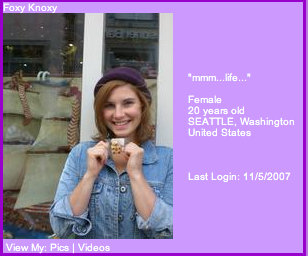
Amanda Knox

Almost exactly two years ago, I wrote one of the first articles to note the phenomenon of "personal" social networking profiles and blogs suddenly becoming very public due to their author's notoriety after a newsworthy event: a piece about 14-year-old Kara Borden and her 18-year-old paramour, David Ludwig. David was convicted of killing Kara's parents when they refused to allow her to date him. Their online profiles provided reporters and the public a small window into a relationship that led to tragedy.

Since then, we've seen countless examples of news organizations using information from the Facebook, MySpace and YouTube accounts of individuals who become newsworthy due to crime and scandal. The latest involves a University of Washington student, Amanda Knox, age 20, who allegedly aided and abetted the murder of her roommate, Meredith Kercher, 21, a British exchange student, while the two were studying abroad in Italy.

The sordid details of the murder drew international attention. At first, the police were baffled. They looked through the victims Facebook pictures for clues.

After a friend of the victim mentioned strange men that had visited the apartment with Amanda, the victims roommate was questioned. Amanda's story didn't seem to add up. She acted odd and changed her story when confronted by police. Then Amanda's online profiles were uncovered.

Amanda had a MySpace and Facebook profile, and even was featured in a short YouTube video. In the context of the grisly murder, Amanda's online persona takes on a chilling tone.

On her MySpace page, Amanda goes by the handle "Foxy Knoxy" The British press has already adopted this nickname to refer to Amanda in their sensational headlines. Schoolmates allege Amanda was constantly bringing strange men to her apartment for sex.

Her profile states that she doesn't drink or smoke, but her YouTube video seems to indicate otherwise:


In her MySpace blog, she wrote a short story about the drugging and rape of a young woman:

"A thing you have to know about chicks is that they don't know what they want," one of her characters says.

Her MySpace account links her to one of the other suspects involved. A man she allegedly carried out the crime with is referred to on the MySpace page:
"I've been working every night (except for Monday night) from 10pm to 2.30am at a bar called Le Chic. It's a really small place owned by this man from the Congo. His name is Patrick."
News outlets have picked up on all this. The Seattle Post-Intelligencer questions whether or not online profiles are "fair game" for journalists to pick at. As the Seattle Crime Blog puts it, sarcastically:
How foolish we reporters are, thinking that something somebody puts up on the Internet is - gasp! - public information. The Internet is "a place to share and be open." ...Amanda Knox was open, and the media is sharing. Shocking, I know.
As I said two years ago, an online profile will never give an exact picture of a person, infamous or not. But in the case of sudden noteriety, everything on an online profile becomes open to interpretation. Reporters and the public seek out an online profile so they can attempt to sort out who a person is. Amanda is vehemently defended by friends back home, but pretty much vilified in this news article. What side of the story does the online profile, the only thing actually written by the defendant, seem to support? On one hand, Amanda liked Disney's The Lion King and listed her mom as her hero. On the other hand, she wrote stories about rape and refered to herself with a sexual nickname. How wholesome was she?

Amanda's MySpace Pictures
Amanda's (Now Public) MySpace Pictures

It's an answer the courts will decide for sure, but for now, Amanda's online persona invites the world to speculate. Amanda, like Kara and David before her, serve as reminders that online profiles are very public indeed, and users would be wise to be concious of what they reveal. Amanda is just the latest MySpacer to find that, in times of trouble, your "My Space" can become everyone's.

----------------

Meredith's friends have set up a Facebook Group in her memory.

Thursday, August 02, 2007

Facebook For Families

Who said Facebook was just a fun diversion?

Facebook Reunites Mother And Son

Thursday, July 12, 2007

Facebook Photos Threaten Miss New Jersey Crown

Amy Shows Her Vegetables

There she is, Miss A... hey, are those mini pumpkins?

Poor Amy Polumbo. She acheived every girl's dream, to become a sex obj... er.. I mean, role model for millions when she was chosen as the next Miss New Jersey. But now her crown is being threatened by pictures she posted on the popular social networking site, Facebook.

Polumbo made the mistake of thinking that pictures of a hot girl posted on the internet somehow won't become public. Even girls who didn't post the pictures themselves can become an internet phenomenon, as Allison Stokke found out. While Polumbo's pictures are tame, she never gave a thought to how they might look in someone else's eyes. In the Facebook era, can we afford to make her mistake?

I thought about myself. What pictures have I posted on Facebook that could come back to bite me when I become a famous astronaut/actor/President? I decided to do a thourough search through my albums, to see if any of my pictures could be interpreted as less than innocent:

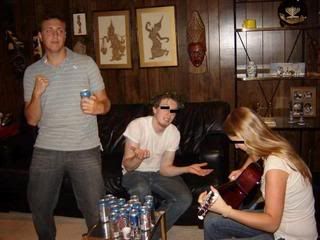
Exhibit #1:

Dancin, Drinkin

Con: Dancing Badly

Pro: I look pretty good.

Con: Cans of beer everywhere, one in my hand, implies drinking.

Pro: I was 21-plus.

Con: This picture was taken at my parents house while they were away.

Conclusion: All in all, I don't think this hurts my aspirations. Except for my dream to be on So You Think You Can Dance. Reputation fairly intact.

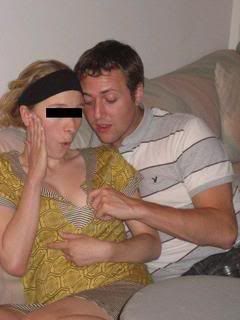
Exhibit #2:

Me and a Girl

Con: I appear to be sneaking a peek.

Pro: The girl doesn't seem to mind.

Con: I've just lost the evangelical vote.

Pro: They wouldn't vote for a Jewish guy anyway.

Conclusion: Men in our society are granted a lot more leeway than women. A fortunate double-standard for me. George W. Bush had his youthful hijinx, and so did I. His involved cocaine though. Reputation with the ladies mildly damaged.

Exhibit #3:

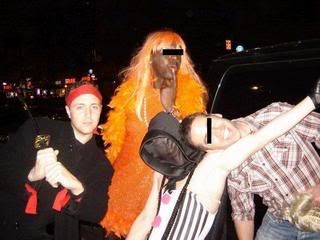
Halloween

Con: Are you looking at the picture???

Pro: This may help me win the gay vote.

Con: NASA doesn't allow ninjas in space.

Con: Readership of this blog just dropped to zero.

Conclusion: Halloween is a holiday when most people dress (and act) like a completely different person. Polumbo had her share of scandalous Halloween photos. Still, the ridiculousness of this photo is alarming. Reputation: Destroyed.

Well, there you have it. Turned out, pictures I thought were harmless took on a sinister and an alarming tone when viewed through analytical eyes. Let this serve as a warning to you, dear reader. Think before you post.

And keep your ninja sword safely sheathed.

Tuesday, April 17, 2007

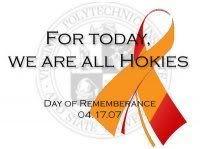
Media Using Facebook To Exploit Learn More About Tragedy

From A Facebook Group

Media outlets at home and abroad are employing social networking technology to gain insight into the Virginia Tech tragedy.

The name of the Virginia Tech murderer (which I will not use here) has been released to the media, as have the names of the first few victims. In this digital age, where more and more people have online profiles, it was only a matter of time before curious individuals looked up the killer's and victims' Facebook and MySpace accounts.

The killer does not have an online profile, but his first victim does. His alleged girlfriend A freshman English Major at Virginia Tech. A facebook tribute group to her was created by two boys at different schools, who apparently knew the girl from high school. The group's message board, in addition to featuring memories and words of support from friends, contains messages from individuals claiming to be from large media organizations.

Matt Davidowitz, from Hofstra, writes:

I am writing as a member of Inside Edition, the television news magaziine [sic]. I know that this is a difficult time for everyone who knew Emily. It seems as if anyone who knew her was the better for it. If anyone would be willing to talk about Emily and everything she was a part of, please call me at (212) 817-5458. We have people on the VT campus who would can go where ever you would need them to. If you are hesitant, and haven't decided whether to talk to the media yet, please call me and we can discuss it further. Thanks.

-Matt
James Clothier, from London, writes:

I know it's a difficult time to hear from journalists, but over here in England it's the only thing people are talking about. Were any Brits out there who want to talk?
I'm writing from The Sun, in London. Phone is 0044207 782 4104.
In a different Facebook group, dedicated to all the victims, Bradley Olson from UPenn writes:

My name is Brad Olson and I'm a reporter for the Baltimore Sun. I'm trying to write a story putting together accounts from many people about what happened yesterday. I know this isn't easy for anyone, but we're trying to something that explains what went on, and how everyone is coping. Anyone who wouldn't mind writing me what happened to you on 4/16, or speaking to me about your experiences for five minutes, please e-mail at bradnews@gmail.com.
Clearly, the media is realizing that social networks, Facebook especially, can be a useful resource when tragedies on college campuses occur. The student body is immediately accessible, and if a reporter has a Facebook account based at Virginia Tech, the detailed profiles of the victims are available to be viewed and to gather information from. There's a disturbing voyeuristic quality to it all.

Brad Olson apparently uses web forums for stories often. A story he wrote about a Naval Academy spring break trip got this response from a reader: "Your newspaper's standards have reached a new low. Bradley Olson has taken unsubstantiated rumors confirmed by anonymous Web site forum sources and, with no facts, has attempted to smear the academy."

That said, Brad isn't alone in using public forums on the web to gain insight into breaking news events. But that criticism should serve as a warning to reporters that may decide to rely on information gleaned from Facebook profiles when writing stories about the victims. The information Facebookers post on their profiles isn't always true, and isn't always what they'd like known by those outside their circle of friends. One can only hope the media is responsible and doesn't tread too much on the personal space of the Virginia Tech victims and their friends and families.

Visitor Map: