About a year ago, I opined that Apple was flirting with old ideas and possibly stunting their culture of innovation. Now we hear more troubling news that Apple is going ahead with products of questionable utility: a bigger iPhone and an iWatch.
The argument for a bigger iPhone boils down to this-- competitors have offered bigger smartphones, so Apple should follow suit to take back lost market share. This makes a very big assumption-- that people buy larger smartphones because of their size. It's an assumption based primarily on the sales of one phone-- Samsung's Galaxy Note II, which runs the Android operating system. But I have yet to see conclusive evidence that a larger screen is the difference that influences most smartphone buyers. I have no doubt that Apple will be able to sell a version of their most popular device with a differently sized screen-- they've done it with the iPad mini. The problem is, the iPad mini cannibalized sales of the full-size iPad, a more profitable product. Whatever market share it grabbed from Amazon's Kindle and Barnes and Noble's Nook, it's been a dubious boost to Apple's fortunes, and a likely reason for that stock slide.
As for the iWatch... I don't believe there is an argument that can be made for it. Even the slickest-looking iWatch will fail because of a watch's inherent limitations. You've got to develop wireless headphones because no one wants a wire running down their arm. You're got to convince people that your design will compliment whatever style they're wearing (something you have to consider whenever something is worn, rather than pocketed). Even overcoming those hurdles, you've still got to deal with the fact that you've just prevented a usable hand from operating the device, and you've got to develop an interface that's useful within such tiny confines. If they're just making the iPod nano with a wrist strap, how is that different from what's already available for a lot cheaper?
Neither of these ideas creates an entirely new revenue stream. What they do is segment an existing revenue stream into smaller, less profitable chunks. I'm not sure how that's a recipe for success. Simply putting a product out there as an alternative to your competitors is not a growth strategy, it's a holding pattern. It's as if Apple is at the gates of El Dorado, and instead of just going inside and grabbing the gold, they're going after the guys selling cheap souvenirs by the side of the road.
Google, on the other hand, seems to have their gaze fixed firmly on the future. Take out the Android operating system, and the online advertising, and you don't have much currently in terms of money-makers. But they've created the most comprehensive map, directory, and database of the world--necessary framework for their future products, such as real-time augmented reality (Google Glasses) and self-driving cars. They've also begun introducing Google Fiber--free, fast internet--to cities around the country, part of an infrastructure that can increase the usefulness and reliability of Google Glasses and Android phones, as well as make in-development ideas like "Smart" homes (and even "Smart" neighborhoods) a real possibility. Apple users found out how far ahead Google's data is after the Apple Maps debacle. While Apple's been sitting on cash it doesn't know what to do with, Google has spent millions on R&D building a support network for the interconnected world we all know we're headed towards.
Maybe Apple can wake up and recognize their (shrinking) lead in online content
distribution, and turn Apple TV from a niche set-top accessory into a
more comprehensive experience (i.e. an Apple flat-screen TV). But we haven't heard about that good idea for a while. Only the uninspired ones.
Imagine the future, and it's not a bunch of people staring down at their wristwatches. Changing a screen size doesn't change anything else. Google understands this--so they're building the foundations of the future, and they're offering a glimpse of the products that will take advantage of it.
If Tim Cook wants to keep Apple on top, he should take note of that.
Showing posts with label google. Show all posts
Showing posts with label google. Show all posts
Tuesday, February 12, 2013


Thursday, September 27, 2012
Apple's Blunder Not A Blunder... Yet
You've probably seen the flat Eiffel Tower, post-apocalyptic San Francisco, Brooklyn's new location in Manhattan (and vice versa), and other hilarious (or annoying, depending on your level of iPhone maps dependence) gaffes included in the new iOS 6 maps program. Apple's decision to replace Google Maps in their new iPhone operating system with.a far inferior navigational tool has caught a lot of heat, and for good reason.
But Apple's stock fell from the $700 dollar level to around $678 at recent trading, and already, some analysts are calling the fiasco "Apple's undoing."
Okay, let's hold up a second. This might not be so bad for Apple. Actually, it might work out quite well.
This is undeniably a hiccup in Apple's mobile dominance. Whether it's more than that depends on the next moves by Google and Apple...
1. Google's move. Clearly, Google has emerged a big winner from Apple's iPhone maps blunder. Like the locked out NFL referees, their value to the iPhone was largely taken for granted. It took Apple "locking Google out," for iPhone customers to recognize Google's superiority over "replacements." It goes beyond maps... Google is also responsible for the phone's default search capability and the algorithms that figure out from your typos and bad grammar what you really mean to look for. Before this episode, users rarely distinguished the built in Google apps from the iPhone package. Suddenly, the wonderful, amazing iPhone looks like a wonderful, amazing piece of hardware running some pretty wonderful, amazing Google apps.
And here is the advantage for Google: without Google Maps and other Google products on the iPhone, Android phones are suddenly much more attractive. The fact that these popular and useful services are available on Android phones could cause some users to switch, and attract new smartphone buyers. If GPS and getting around is a priority for you, you'd be hard-pressed to make a case for the iPhone's cribbed-from-GPS-devices-crica-1999 navigation quality.
Google could, in theory, not release its products to work on the iPhone, releasing them exclusively for Android.
However, indications are that Google is developing a Google Maps app to be available through the Apple App Store. A modest charge for these apps could potentially make up for the loss in licensing fees Apple used to pay them. Or the app could make money by being ad-supported, and we all know Google is the king of mobile advertising.
Either way, Google wins. If they hold onto Google maps for Android, they gain a marketing advantage. If they sell it through the Apple App Store, or offer the app with ads, they retain some marketing advantage (its free on Android, $$$ or ads on iPhone) while making money on the side.
2. Apple's move. Apple certainly could block Google's apps from the App Store. But doing so wouldn't provide any benefit for them. By shutting out Google, they'd be conceding a pretty big advantage to Android. Use the iOS maps for 5 minutes and argue that Apple is EVER going to catch up to Google. You can't. The "search" company has spent more than a decade and millions of dollars on development, and it's created the most up-to-date, most detailed digital representation of our world that's possible with current technology. Apple took out a dusty atlas and painted Salvador Dali images on it.
Also, Apple has nothing to lose by allowing the Google Maps app and other Google apps to be sold. Apple reaps a large percentage every time someone makes an App store purchase. In effect, instead of paying a licensing fee to Google... they can now make money every time a Google app is sold.
As stated earlier, Google could offer a free app, supported by advertising. Apple wouldn't make any percentage from that. But they also wouldn't lose any marketing advantage to Android, and they still wouldn't need to pay Google a licensing fee.
If this all goes according to plan, then really, the shift to those terrible Apple maps wasn't a blunder at all, but a calculated move to save money on licensing fees and possibly make more money by taking commission off of Google app sales.
The only way this doesn't work out for Apple is if Google withholds their apps exclusively for Android. But Google would have to calculate that the income raised by increased Android purchases would outweigh the money to be made by selling apps in the Apple App Store or selling advertising against a free app. Clearly, Google is developing an iOS app, so they've made their decision already.
"Apple's undoing?" Hardly. This blunder could end up being a money maker for both Apple and Google. In essence, its a more efficient way of getting the companies to work together, without pesky contracts and licensing fees littering the battleground.
But Apple's stock fell from the $700 dollar level to around $678 at recent trading, and already, some analysts are calling the fiasco "Apple's undoing."
Okay, let's hold up a second. This might not be so bad for Apple. Actually, it might work out quite well.
This is undeniably a hiccup in Apple's mobile dominance. Whether it's more than that depends on the next moves by Google and Apple...
1. Google's move. Clearly, Google has emerged a big winner from Apple's iPhone maps blunder. Like the locked out NFL referees, their value to the iPhone was largely taken for granted. It took Apple "locking Google out," for iPhone customers to recognize Google's superiority over "replacements." It goes beyond maps... Google is also responsible for the phone's default search capability and the algorithms that figure out from your typos and bad grammar what you really mean to look for. Before this episode, users rarely distinguished the built in Google apps from the iPhone package. Suddenly, the wonderful, amazing iPhone looks like a wonderful, amazing piece of hardware running some pretty wonderful, amazing Google apps.
And here is the advantage for Google: without Google Maps and other Google products on the iPhone, Android phones are suddenly much more attractive. The fact that these popular and useful services are available on Android phones could cause some users to switch, and attract new smartphone buyers. If GPS and getting around is a priority for you, you'd be hard-pressed to make a case for the iPhone's cribbed-from-GPS-devices-crica-1999 navigation quality.
Google could, in theory, not release its products to work on the iPhone, releasing them exclusively for Android.
However, indications are that Google is developing a Google Maps app to be available through the Apple App Store. A modest charge for these apps could potentially make up for the loss in licensing fees Apple used to pay them. Or the app could make money by being ad-supported, and we all know Google is the king of mobile advertising.
Either way, Google wins. If they hold onto Google maps for Android, they gain a marketing advantage. If they sell it through the Apple App Store, or offer the app with ads, they retain some marketing advantage (its free on Android, $$$ or ads on iPhone) while making money on the side.
2. Apple's move. Apple certainly could block Google's apps from the App Store. But doing so wouldn't provide any benefit for them. By shutting out Google, they'd be conceding a pretty big advantage to Android. Use the iOS maps for 5 minutes and argue that Apple is EVER going to catch up to Google. You can't. The "search" company has spent more than a decade and millions of dollars on development, and it's created the most up-to-date, most detailed digital representation of our world that's possible with current technology. Apple took out a dusty atlas and painted Salvador Dali images on it.
Also, Apple has nothing to lose by allowing the Google Maps app and other Google apps to be sold. Apple reaps a large percentage every time someone makes an App store purchase. In effect, instead of paying a licensing fee to Google... they can now make money every time a Google app is sold.
As stated earlier, Google could offer a free app, supported by advertising. Apple wouldn't make any percentage from that. But they also wouldn't lose any marketing advantage to Android, and they still wouldn't need to pay Google a licensing fee.
If this all goes according to plan, then really, the shift to those terrible Apple maps wasn't a blunder at all, but a calculated move to save money on licensing fees and possibly make more money by taking commission off of Google app sales.
The only way this doesn't work out for Apple is if Google withholds their apps exclusively for Android. But Google would have to calculate that the income raised by increased Android purchases would outweigh the money to be made by selling apps in the Apple App Store or selling advertising against a free app. Clearly, Google is developing an iOS app, so they've made their decision already.
"Apple's undoing?" Hardly. This blunder could end up being a money maker for both Apple and Google. In essence, its a more efficient way of getting the companies to work together, without pesky contracts and licensing fees littering the battleground.
Wednesday, February 22, 2012
Google Glasses, and Is Apple On The Wrong Side Of Innovation?

The New York Times Bits Blog has a piece yesterday about Google's new technology venture: Google Glasses. According to the blog's sources, the glasses will resemble a bulky pair of late-90s Oakleys, cost $250-$600 dollars, and feature augmented reality--data showing up before your eyes when you look at something, like a star review when you look at a restaurant you're passing by.
The concept isn't new, but it is a prominent vision of where we're headed in mobile computing. Today's smartphones require us to look down to access information-- there's a clear advantage in a smart device that allows us to look up.
However, it doesn't seem like Google Glasses are ready for prime time, and it doesn't look to me like they will be. There are a couple problems I see:
1. It's a pair of bulky, late 90s Oakleys.
Many people say that the iPhone is a fashion statement. Which refers to its smart, sleek design and ubiquitous popularity. But it's also something that you keep in your pocket. Glasses are, quite literally, "in your face." Sunglasses are a deeply personal object, unique to one's style. And there's a reason why Oakleys' heyday was over a decade ago.
2. They're glasses.
People who don't need glasses don't wear them, unless they're sunglasses. People who do need glasses have eyeglasses that won't fit under a pair of Oakleys. The 3D trend is stuck on this same obstacle-- people feel uncomfortable with glasses (or extra glasses) on their face.
3. The money quote from the NY Times article: "The navigation system currently used is a head tilting to scroll and click. We are told it is very quick to learn and once the user is adept at navigation, it becomes second nature and almost indistinguishable to outside users.”
Oh boy. Engineers are in love with finding new ways to navigate the devices they put in front of us. First, they came up with punch cards. Then scroll wheels. Then the mouse. The joystick. Finally-- the touchscreen. Apple's navigation system worked because it was so intuitive: when we pick up something to take a closer look, we "pinch," when we drop something, we spread our fingers. This is the way we've always navigated with real objects-- Apple translated it to the smartphone.
This head tilt thing? "Quick to learn," and "second nature" and "almost indistinguishable" to people looking at us? Read between the lines and the picture you get is a twitchy man bobbing his head about while onlookers wonder if they're witnessing epilepsy or a the beginnings of a stroke.
And our heads move a lot. Can the device tell our intentions with such precision? If I turn my head to look at a hot chick or move quickly to dodge falling bird doo, will I accidentally email my mom or dial a number in Taipei?
Why not create a navigation system based on iris movement and the simple "double blink?" Looking around would move the cursor or scroll, and a double blink (which people would normally not do) would make a selection. That's far more intuitive than nodding and bobbing.
4. The biggest hurdle is response speed. The reason augmented reality apps are nothing more than a novelty right now is that they don't work fast enough. By the time something loads, your gaze has shifted. If you have to stare at something for a long time in order for Google Glasses to show you the relevant data, then why not just pick up a smart phone instead? No one likes to uncomfortably stare at something for more than a second or two. Is 4G fast enough to deliver the data? Are the GPS, the cameras and the chipset all integrated to generate results fast-- as fast as the blink of an eye?
With all this said, Google is at least on the right track. Some type of heads-up display is the future, I'm convinced. Which is why a line near the bottom of the blog post gives me concerns about Google's competitor, Apple:
"Apple engineers are also exploring wearable computing, but the company is taking a different route, focusing on computers that strap around someone’s wrist."
Yikes. So Google cops Oakleys, while Apple goes after the Casio Calculator Watch?

There's a reason the watch market collapsed following the explosion of cell phones. Watches are no longer a utility. They've become merely a fashion item. Like glasses, people buy they to match their personal style. Expecting to mass market one style of watch the same way Apple sells one style of cell phone is a boneheaded expectation.
The wristwatch concept doesn't solve any problem... indeed, it creates new ones. Yes, your hands are free, but in order to navigate, you're forced to keep one arm immobile while the other one touches. You're looking down, not up. You require a separate device to hear (glasses, at least, are close enough to the ear to incorporate a built-in headphone. I mean... wristwatch? Really?
This revelation comes on the heels of new photos that show the new iPad 3 will be THICKER than the iPad 2. While it seems the difference is no more than 1.5 millimeters, and improvements to the display and camera account for the extra space, its hard to believe Apple couldn't shave down the extra millimeter to avoid the perception of going backwards. If faster, smaller, lighter are the watchwords for future tech, Apple's fatter iPad sequel has been set up for obsolescence.
For Apple to continue its lead in the mobile computing field, they need to show they're thinking forward. Google's Glasses concept at least shows an eye looking ahead. Apple's wrist watch and belly-busting iPad 3 seem to indicate they may be staring at their feet.

The New York Times Bits Blog has a piece yesterday about Google's new technology venture: Google Glasses. According to the blog's sources, the glasses will resemble a bulky pair of late-90s Oakleys, cost $250-$600 dollars, and feature augmented reality--data showing up before your eyes when you look at something, like a star review when you look at a restaurant you're passing by.
The concept isn't new, but it is a prominent vision of where we're headed in mobile computing. Today's smartphones require us to look down to access information-- there's a clear advantage in a smart device that allows us to look up.
However, it doesn't seem like Google Glasses are ready for prime time, and it doesn't look to me like they will be. There are a couple problems I see:
1. It's a pair of bulky, late 90s Oakleys.
Many people say that the iPhone is a fashion statement. Which refers to its smart, sleek design and ubiquitous popularity. But it's also something that you keep in your pocket. Glasses are, quite literally, "in your face." Sunglasses are a deeply personal object, unique to one's style. And there's a reason why Oakleys' heyday was over a decade ago.
2. They're glasses.
People who don't need glasses don't wear them, unless they're sunglasses. People who do need glasses have eyeglasses that won't fit under a pair of Oakleys. The 3D trend is stuck on this same obstacle-- people feel uncomfortable with glasses (or extra glasses) on their face.
3. The money quote from the NY Times article: "The navigation system currently used is a head tilting to scroll and click. We are told it is very quick to learn and once the user is adept at navigation, it becomes second nature and almost indistinguishable to outside users.”
Oh boy. Engineers are in love with finding new ways to navigate the devices they put in front of us. First, they came up with punch cards. Then scroll wheels. Then the mouse. The joystick. Finally-- the touchscreen. Apple's navigation system worked because it was so intuitive: when we pick up something to take a closer look, we "pinch," when we drop something, we spread our fingers. This is the way we've always navigated with real objects-- Apple translated it to the smartphone.
This head tilt thing? "Quick to learn," and "second nature" and "almost indistinguishable" to people looking at us? Read between the lines and the picture you get is a twitchy man bobbing his head about while onlookers wonder if they're witnessing epilepsy or a the beginnings of a stroke.
And our heads move a lot. Can the device tell our intentions with such precision? If I turn my head to look at a hot chick or move quickly to dodge falling bird doo, will I accidentally email my mom or dial a number in Taipei?
Why not create a navigation system based on iris movement and the simple "double blink?" Looking around would move the cursor or scroll, and a double blink (which people would normally not do) would make a selection. That's far more intuitive than nodding and bobbing.
4. The biggest hurdle is response speed. The reason augmented reality apps are nothing more than a novelty right now is that they don't work fast enough. By the time something loads, your gaze has shifted. If you have to stare at something for a long time in order for Google Glasses to show you the relevant data, then why not just pick up a smart phone instead? No one likes to uncomfortably stare at something for more than a second or two. Is 4G fast enough to deliver the data? Are the GPS, the cameras and the chipset all integrated to generate results fast-- as fast as the blink of an eye?
With all this said, Google is at least on the right track. Some type of heads-up display is the future, I'm convinced. Which is why a line near the bottom of the blog post gives me concerns about Google's competitor, Apple:
"Apple engineers are also exploring wearable computing, but the company is taking a different route, focusing on computers that strap around someone’s wrist."
Yikes. So Google cops Oakleys, while Apple goes after the Casio Calculator Watch?

There's a reason the watch market collapsed following the explosion of cell phones. Watches are no longer a utility. They've become merely a fashion item. Like glasses, people buy they to match their personal style. Expecting to mass market one style of watch the same way Apple sells one style of cell phone is a boneheaded expectation.
The wristwatch concept doesn't solve any problem... indeed, it creates new ones. Yes, your hands are free, but in order to navigate, you're forced to keep one arm immobile while the other one touches. You're looking down, not up. You require a separate device to hear (glasses, at least, are close enough to the ear to incorporate a built-in headphone. I mean... wristwatch? Really?
This revelation comes on the heels of new photos that show the new iPad 3 will be THICKER than the iPad 2. While it seems the difference is no more than 1.5 millimeters, and improvements to the display and camera account for the extra space, its hard to believe Apple couldn't shave down the extra millimeter to avoid the perception of going backwards. If faster, smaller, lighter are the watchwords for future tech, Apple's fatter iPad sequel has been set up for obsolescence.
For Apple to continue its lead in the mobile computing field, they need to show they're thinking forward. Google's Glasses concept at least shows an eye looking ahead. Apple's wrist watch and belly-busting iPad 3 seem to indicate they may be staring at their feet.
Friday, June 19, 2009
Search Engines Sweep Nation
First, there was Yahoo!. Then there was Altavista, Lycos, Ask. Finally, there was Google. How many search engines did the world really need?
Well, this month, there's been an eruption of new, "improved," "super-cool," search engines. First, Microsoft announced their latest attempt to beat Google into a bloody pulp and wrap the corpse in a rug: Bing.com. While I don't think anyone will be saying, "I just 'binged' my blind date... I've got to cancel," the site has some very cool features. Chief among them? Their video search, in which you can see full length thumbnail sized versions of every video that comes up in your search results. This is fantastic for watching stuff during work.
But we'd expect a Google-killer attempt from Microsoft. Others, by smaller companies, show that while Google may be a household name, there's plenty of room for other search websites in the marketplace:
Taptu Dancing: One of the biggest complaints about the iPhone is that its web browser doesn’t support Flash animation, which is used on many web pages. And on any cell phone, it can be difficult to find a mobile version of the page you want. Taptu is a downloadable search app that filters out pages featuring Flash and optimizes the search results for viewing on an iPhone or any other mobile device. You can see how it works at taptu.com.
I Have A Hunch: Created by the people who brought you Flickr, Hunch.com is billed as a “decision-making engine.” The website asks you a series of questions designed to gauge your personality, wants and needs (for example, “Do you like bumper cars?”) Then you type in what you’re looking for, such as “Where to go on vacation?” and the site offers results that match what it has learned about you from your answers. The site is designed to adapt as more users ask and answer questions, to improve the accuracy of the results.
Who's Afraid Of The Big Bad Wolfram Alpha: Search for your name on any major search site, and you’ll find a lot of personal websites, news stories, PDF files of your alumni newsletter. But on Wolframalpha.com, a search for your name brings up the number of people in the U.S. that have your name, what years it was most popular in, and how old, on average, people with your name are. Wolfram Alpha provides numerical facts and figures on many topics, though at this stage, there are still some gaps in its knowledge. All it told me about Jessica Alba was that she was born on April 28, 1981 in Pomona, California. Not even a picture? Come on, Wolfram.

That's More Like It. Thanks Bing!
Pass The Koogle, Bubbe- Announced this week, Koogle is a search engine designed for Orthodox Jews, who aren’t allowed to view “immodest” images and other un-kosher search results that may pop up (the name is a play on Google and that popular Jewish dish, kugel). While there are clearly some bugs to work out (some searches result in a 404 Not Found page), its creators hope the site enables the Orthodox community to use the web without fear of compromising their values and beliefs. For instance, I typed in "Jessica Alba," and the website nearly exploded.
Yes, I know she has a baby now and the body can't possibly still be that hot. But let's appreciate the way it was, okay?
Of course, the best search engine is the one at the top of this page, where you can search for things I've written on this blog. It looks like this:

Type in a word, and you'll find out what I think about it. If nothing comes up, then that means whatever you're searching for is terribly, terribly unimportant.
First, there was Yahoo!. Then there was Altavista, Lycos, Ask. Finally, there was Google. How many search engines did the world really need?
Well, this month, there's been an eruption of new, "improved," "super-cool," search engines. First, Microsoft announced their latest attempt to beat Google into a bloody pulp and wrap the corpse in a rug: Bing.com. While I don't think anyone will be saying, "I just 'binged' my blind date... I've got to cancel," the site has some very cool features. Chief among them? Their video search, in which you can see full length thumbnail sized versions of every video that comes up in your search results. This is fantastic for watching stuff during work.
But we'd expect a Google-killer attempt from Microsoft. Others, by smaller companies, show that while Google may be a household name, there's plenty of room for other search websites in the marketplace:
Taptu Dancing: One of the biggest complaints about the iPhone is that its web browser doesn’t support Flash animation, which is used on many web pages. And on any cell phone, it can be difficult to find a mobile version of the page you want. Taptu is a downloadable search app that filters out pages featuring Flash and optimizes the search results for viewing on an iPhone or any other mobile device. You can see how it works at taptu.com.
I Have A Hunch: Created by the people who brought you Flickr, Hunch.com is billed as a “decision-making engine.” The website asks you a series of questions designed to gauge your personality, wants and needs (for example, “Do you like bumper cars?”) Then you type in what you’re looking for, such as “Where to go on vacation?” and the site offers results that match what it has learned about you from your answers. The site is designed to adapt as more users ask and answer questions, to improve the accuracy of the results.
Who's Afraid Of The Big Bad Wolfram Alpha: Search for your name on any major search site, and you’ll find a lot of personal websites, news stories, PDF files of your alumni newsletter. But on Wolframalpha.com, a search for your name brings up the number of people in the U.S. that have your name, what years it was most popular in, and how old, on average, people with your name are. Wolfram Alpha provides numerical facts and figures on many topics, though at this stage, there are still some gaps in its knowledge. All it told me about Jessica Alba was that she was born on April 28, 1981 in Pomona, California. Not even a picture? Come on, Wolfram.
That's More Like It. Thanks Bing!
Pass The Koogle, Bubbe- Announced this week, Koogle is a search engine designed for Orthodox Jews, who aren’t allowed to view “immodest” images and other un-kosher search results that may pop up (the name is a play on Google and that popular Jewish dish, kugel). While there are clearly some bugs to work out (some searches result in a 404 Not Found page), its creators hope the site enables the Orthodox community to use the web without fear of compromising their values and beliefs. For instance, I typed in "Jessica Alba," and the website nearly exploded.
Yes, I know she has a baby now and the body can't possibly still be that hot. But let's appreciate the way it was, okay?
Of course, the best search engine is the one at the top of this page, where you can search for things I've written on this blog. It looks like this:
Type in a word, and you'll find out what I think about it. If nothing comes up, then that means whatever you're searching for is terribly, terribly unimportant.
Tuesday, October 07, 2008
Google Saves Drunken E-mailers
I admit, I've sent some regrettable e-mails. You have too. Sometimes, it's just because we were emotional at the time. Most likely-- especially now that we have email on our portable iPhones and Crackberries-- we were drunk.
The folks at Google feel our pain. Or rather, they want to spare us the pain of sending a drunken email that will later come back to haunt us:
"Yeah, um, boss... about that email I sent on Saturday at 3:00 am... just kidding, I don't want to quit. And I meant to call someone else a weasel."
World, meet Mail Goggles. Turn this feature on, and every time you try and send an email late at night on a weekend, Google will present you with a few math problems to solve before it sends. The logic being-- if you're in the right frame of mind to do math, then you're in the right frame of mind to send an email:
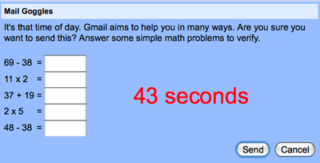
See, your teachers were right! Math isn't useless.
Of course, Mail Goggles isn't for everyone. For instance, those bad at elementary school math. And those with Arithmophobia: you're already drunk... adding blood-curdling numbers to the mix can only make your state of mind worse.
But for the rest of us, Mail Goggles can be a very useful tool. Why not extend mind-engaging academic tests to protect us from other erroneous communication? Solve a crossword before you can send that late night "What You Up To?!?" text message to your ex. Name the 12th U.S. President before drunk dialing. Analyze the use of allegory in Joseph Conrad's "Heart of Darkness" before writing on your crush's Facebook wall during a Saturday pre-dawn bender.
Imagine. Suddenly, there would be a purpose to grade school: preventing us from making asses of ourselves.
Which, apparently, was the original purpose of grade school.

Maybe The Wonder Years' Chick Is On To Something
Anyways, the Jewishholiday I'm-Sorry-Fest of Yom Kippur is happening this week, so if you have sent a regrettable email, now's the time to apologize, beg forgiveness and repent. Cause even if you're not Jewish, you want to be sure you've got your bases covered, right?
Now if you'll excuse me, I have some math to study up on. I don't want to be stuck if I have to send an email this weekend.
I admit, I've sent some regrettable e-mails. You have too. Sometimes, it's just because we were emotional at the time. Most likely-- especially now that we have email on our portable iPhones and Crackberries-- we were drunk.
The folks at Google feel our pain. Or rather, they want to spare us the pain of sending a drunken email that will later come back to haunt us:
"Yeah, um, boss... about that email I sent on Saturday at 3:00 am... just kidding, I don't want to quit. And I meant to call someone else a weasel."
World, meet Mail Goggles. Turn this feature on, and every time you try and send an email late at night on a weekend, Google will present you with a few math problems to solve before it sends. The logic being-- if you're in the right frame of mind to do math, then you're in the right frame of mind to send an email:
See, your teachers were right! Math isn't useless.
Of course, Mail Goggles isn't for everyone. For instance, those bad at elementary school math. And those with Arithmophobia: you're already drunk... adding blood-curdling numbers to the mix can only make your state of mind worse.
But for the rest of us, Mail Goggles can be a very useful tool. Why not extend mind-engaging academic tests to protect us from other erroneous communication? Solve a crossword before you can send that late night "What You Up To?!?" text message to your ex. Name the 12th U.S. President before drunk dialing. Analyze the use of allegory in Joseph Conrad's "Heart of Darkness" before writing on your crush's Facebook wall during a Saturday pre-dawn bender.
Imagine. Suddenly, there would be a purpose to grade school: preventing us from making asses of ourselves.
Which, apparently, was the original purpose of grade school.
Maybe The Wonder Years' Chick Is On To Something
Anyways, the Jewish
Now if you'll excuse me, I have some math to study up on. I don't want to be stuck if I have to send an email this weekend.
Subscribe to:
Posts (Atom)